Pro Edition
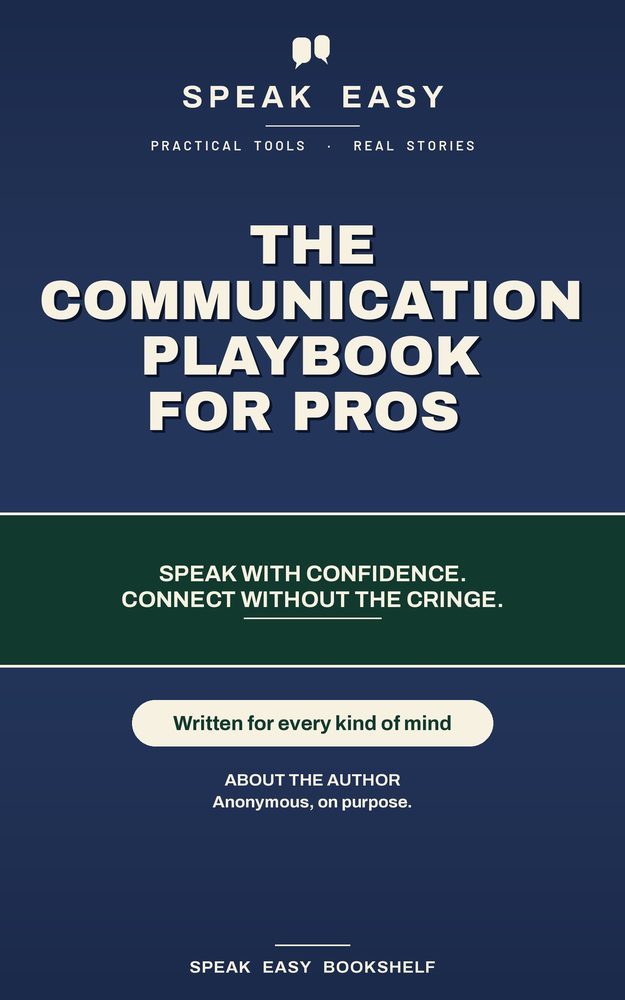
Speak Easy: The Communication Playbook for Pros
The room nodded. The plan died three weeks later. The most junior person there saw it coming and said nothing. This is the book about the conversations that decide a career, and it is built so you can check its work.
Kindle · $12.99 · Out 6 October 2026
Why this, why now
The machines took the routine work. What is left is the room.
The part of a job that does not automate is the part that happens between people at the moment it matters: the renewal, the bad news, the room that was already nodding.
Entry-level roles most exposed to AI are now seven times more likely to require traditionally senior-level “human-intensive” skills like leadership, creativity or face-to-face interactions. Judgement-led roles are growing twice as fast as the roles AI simplified, with salaries rising 42% faster.
PwC, 2026 Global AI Jobs Barometer, 15 June 2026. Drawn from over a billion job ads across 27 countries.What is inside
Twenty-three chapters. Each opens with a room you have already been in.
- You are judged before you open your mouth, and the room spends the rest of the meeting confirming it
- Someone else names a number first, and you spend the meeting arguing inside their definition of the problem
- You fill four seconds of silence and negotiate against yourself
- Something has been wrong with one working relationship for a long time and you cannot point to a single incident that proves it
- You recognise your best person generously and watch them get more cautious
- A short reply lands as a reprimand, and nobody tells you
- You are under pressure and your body is telling the room more than your argument is
- Your case has to survive the sharpest person present, not the average one
Every chapter ends in practice rather than summary: XP Missions at three tiers, Reset Scripts for when the move goes wrong mid-conversation, Role-Play Scenarios with your own words left blank, a TL;DR that carries the citations forward, and a Log It entry.
Appendix A
Twenty-three named methods, and the situation each one is for.
Every chapter ends at one named technique. The Method Index is the fastest route back into the book when something is about to happen and you do not have time to reread a chapter.
Use it when you are walking into a room where the people in it do not know you yet.
Use it when a number, a price, or a starting position is about to be named.
Use it when someone has answered you, and the answer is true but not complete.
Use it when you are about to praise someone and you want the praise to hold up.
Use it when you are about to send something in writing that carries tone.
Use it when you need to know what the room actually thinks and your own seniority is in the way.
Use it when a hard question or a strong offer has landed and nobody is talking.
Use it when you are in the final minute of a conversation that mattered.
Use it when you need to decline something without losing the relationship.
Use it when something has just gone wrong in front of people.
Use it when a first conversation went well and the following weeks will decide whether it meant anything.
Use it when you have felt for a while that something is wrong with one working relationship and cannot point to a single incident that proves it.
Use it when something keeps happening and each instance on its own sounds trivial.
Use it when a negotiation is coming and there is still time to change what it rests on.
Use it when you want to be persuasive and you want to stay on the right side of the line.
Use it when you have to say something the other person will not want to hear.
Use it when you are running the meeting and the agreement feels too easy.
Use it when the pressure is visible and the room needs to see steadiness.
Use it when your case will be examined by someone who wants it to fail.
Use it when you are about to tell a true story in order to move a decision.
Use it when you are entering a room whose norms are not your own.
Use it when a conversation is coming whose outcome you cannot afford to improvise.
Use it when you are giving your role to someone else, or receiving one.
How the practice works
Three tiers, and a habit that makes them stick.
Run the move once, somewhere the stakes are low.
Use it where the outcome actually matters.
Hold it across a month, or under real pressure.
Write down what actually happened. This is what makes a mission still useful in six months.
Two things that run through every chapter
Written for different kinds of minds, with the line drawn in plain sight.
A Note for Different Kinds of Minds
In every chapter, written separately for autistic and ADHD readers. Not a disclaimer. Where the standard advice assumes a social read in the moment that does not describe everyone, the method gets rebuilt rather than softened.
A manipulation guardrail
Every move here has a colder twin that works in the short run and costs you the relationship. Each chapter names its own and draws the line.
Appendix B
134 sources, each tagged to the chapter that cites it.
Research is named in the text with author and year rather than buried in an endnote, so you can check a claim while you are reading it. No single study is cited in more than one chapter, which keeps the argument resting on a wide evidence base rather than a narrow one repeatedly restated.
Where a claim could not be confirmed against the paper itself, it was left out. Several well-known figures that circulate widely in business writing are absent for exactly that reason, and in two places the book says on the page that the popular version of a finding is not what the study reports.
Out 6 October 2026.
Kindle pre-order at $12.99. It delivers automatically on release day.
A single hour with a communication coach costs more than this book, and when the hour is over you have your notes. This is twenty-three methods, 134 sources and 480 pages, with a Method Index built so you can find the right move on the morning you need it rather than the afternoon you paid for it.
Other editions
Same system, different reader.
Adults Edition
Ages 18 and up, 129 pages. Fifteen chapters and nine appendices for adults who were never taught this. Available now.
See the Adults Edition →Teen Edition
Ages 13 to 17, 151 pages. The same twelve core skills for school, group chats and friendships.
See the Teen Edition →Kids Edition
Ages 6 to 12, 65 pages. Taught through Peanut the elephant and illustrated exercises.
See the Kids Edition →FAQ
Questions worth answering.
When does the Pro edition come out?
6 October 2026. It is available now as a Kindle pre-order at $12.99 and delivers automatically on release day.
How is Pro different from the Adults edition?
Adults teaches the twelve core skills for everyday life in fifteen chapters. Pro is the professional build: twenty-three chapters on the conversations that decide careers, with a named method per chapter, 134 cited sources, and worked examples using the actual sentences.
Is every claim in the book sourced?
Yes. Research is named in the text with author and year rather than buried in an endnote, and Appendix B lists 134 references, each tagged with the chapter that cites it. No single study is cited in more than one chapter.
Why is there no author name on the cover?
By design. With no name to lean on, every claim has to carry itself, which is why the research is named in the text and the sources are tagged to the chapter that cites them. Check the citations rather than the author.
Is there a paperback of the Pro edition?
Not at launch. Pro is Kindle only on 6 October 2026. The Adults, Teen and Kids editions are available in both Kindle and paperback.